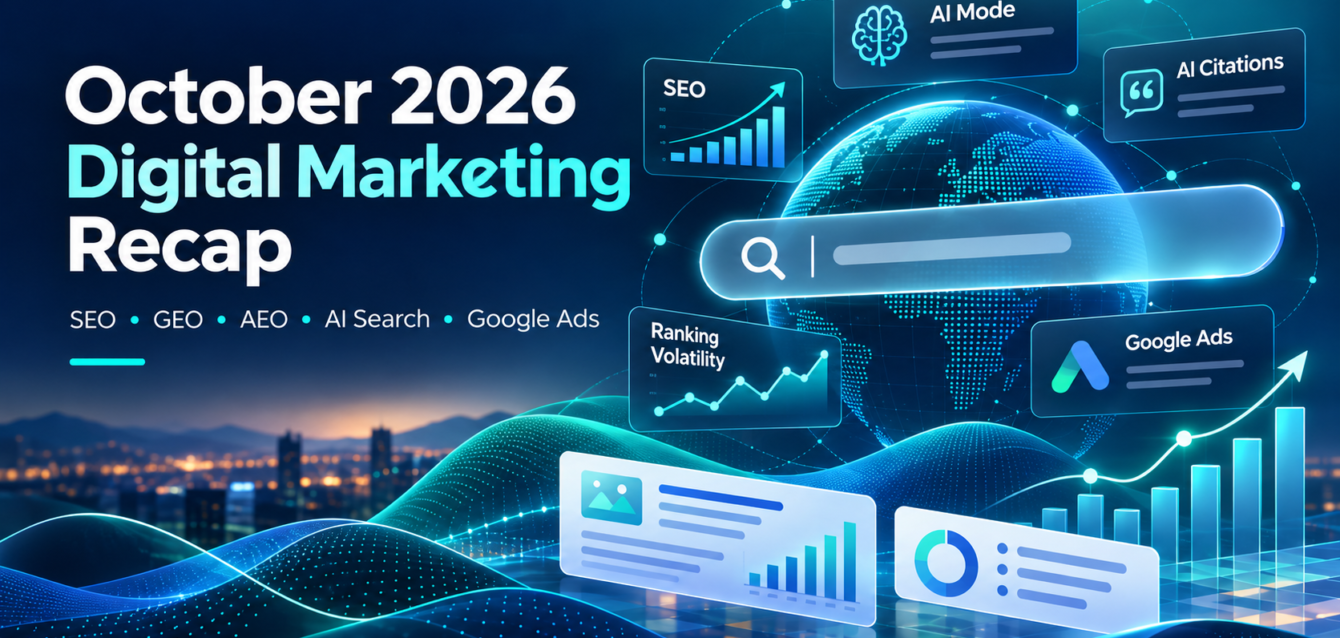
October was another fascinating month in the world of digital marketing, with considerable fluctuations in Google’s organic search results, further developments across its AI-powered search experiences and some particularly interesting research into the performance of AI search platforms.
Whilst there is understandably a great deal of excitement surrounding Generative Engine Optimisation (GEO) and Answer Engine Optimisation (AEO), some of this month’s research provides a valuable reminder of just how important traditional SEO remains. The opportunity lies in understanding how these disciplines complement one another rather than treating them as competing strategies.
Here are five developments that caught our attention during October.
Google search ranking volatility intensifies throughout October
Following the completion of Google’s September spam update on 8 October, the SEO industry experienced several periods of considerable ranking volatility. Barry Schwartz, writing for Search Engine Roundtable, reported significant fluctuations around 16, 20, 21, 24 and 27 October. Although Google did not officially confirm another algorithm update during this period, the fluctuations were noteworthy. For businesses, this reinforces the importance of consistently monitoring organic search performance and taking a measured approach to SEO. Short-term ranking movements shouldn’t necessarily dictate changes to a well-established, long-term SEO strategy.
Read the full article on Search Engine Roundtable
Google introduces more prominent website links within AI search results
On 15 October, Google announced several improvements to AI Mode and AI Overviews designed to encourage users to explore the websites behind AI-generated answers. These include more prominent contextual links within responses, enhanced related article displays and the testing of dedicated sections highlighting official websites. Given the ongoing concerns around AI search reducing organic website traffic, this is an encouraging development. For businesses investing in SEO, AEO and GEO, it reinforces the importance of becoming a credible source of information that Google can confidently reference and direct users towards.
Read the full article on Google’s official blog
ChatGPT generates less than 1% of Google’s organic search traffic
Respected SEO industry expert Marie Haynes analysed 12 months of Google Analytics 4 data across 100 websites, encompassing more than 145 million sessions. The research found that ChatGPT generated just 0.62% of the traffic delivered by Google organic search, increasing to 0.73% when referrals from other large language models were included. Interestingly, ChatGPT visitors demonstrated considerably higher conversion rates amongst the websites tracking conversions. These findings provide some important perspective: whilst AI search presents an emerging opportunity, traditional organic search remains an overwhelmingly important traffic acquisition channel. Businesses should be investing in AI visibility without losing sight of where the majority of their traffic and conversions currently originate.
Read the full article on Search Engine Land
Ahrefs analyses the stability of 37,500 AI citations
Ahrefs published a particularly interesting study examining approximately 37,500 citations across five AI search platforms over a 20-day period. The research found that at least half of the citations disappeared from responses by the following day, with the degree of volatility varying considerably between platforms. This highlights one of the fundamental differences between traditional keyword rankings and AI search visibility. A business being referenced by ChatGPT or Google AI Mode today does not necessarily mean it will be referenced tomorrow. From an AEO and GEO perspective, measuring the frequency and consistency of brand mentions and citations over extended periods is likely to provide a far more meaningful indication of performance than isolated searches.
Read the full research article on Ahrefs
Google expands advertising within AI Mode to 10 additional countries
On the paid search front, Google announced that advertising within AI Mode would expand to 10 additional markets, including Australia, Canada, India, Kenya and Nigeria, with further expansion planned before the end of the year. Google also announced a new advertising format in the United States that allows advertisements to appear in response to follow-up questions within AI Mode conversations. Particularly interesting is Google’s observation that queries within AI Mode are, on average, three times longer than traditional search queries. Although South Africa was not included in this particular expansion, it offers an indication of where paid search is heading and how advertising opportunities are evolving alongside increasingly conversational search behaviour.
Read the full announcement on Google’s Africa blog
SEO remains fundamental, but the opportunity is expanding
Perhaps the most important takeaway from October’s developments is that the rise of AI search should not come at the expense of traditional SEO.
The data continues to demonstrate Google’s dominance as a source of organic website traffic, but measuring traffic alone doesn’t necessarily tell the full story of how AI platforms influence purchasing decisions, brand awareness and customer discovery.
At iMod Digital, we believe the opportunity lies in combining traditional SEO with AEO and GEO, building authoritative websites that perform well in conventional search results whilst increasingly becoming trusted sources of information within AI-generated responses.
Search behaviour is evolving, and businesses that recognise this early, without abandoning the fundamentals that already deliver results, will be well positioned to benefit.