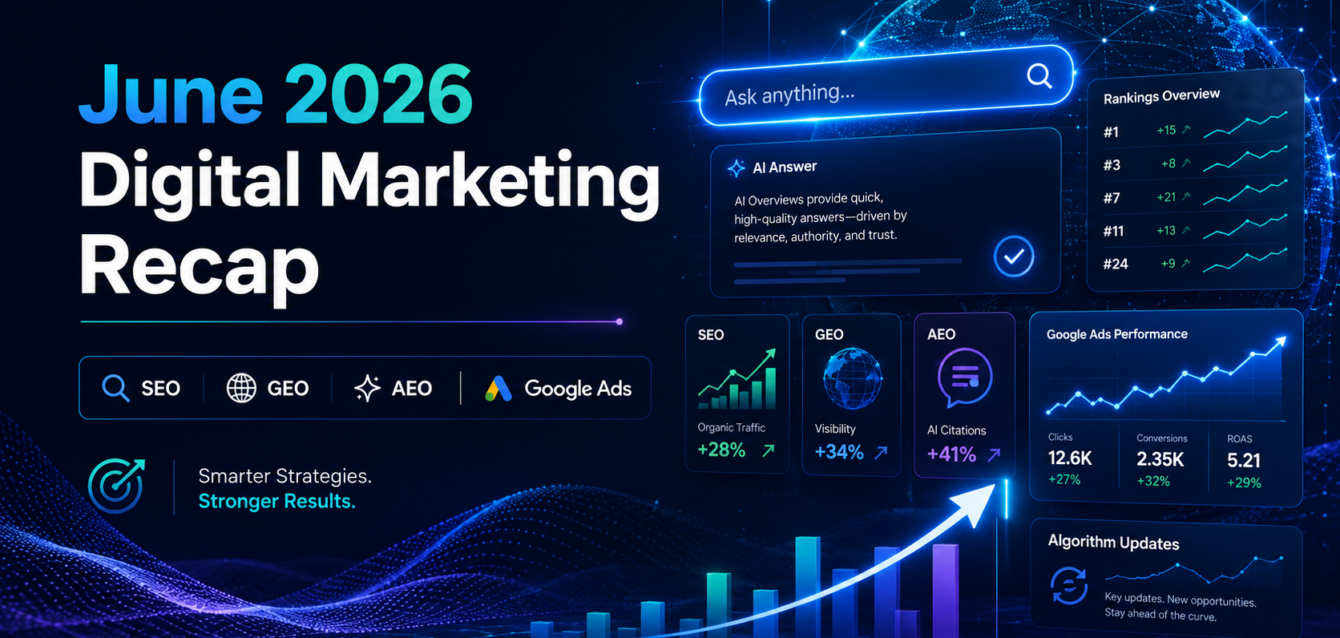
Search continues to move quickly, with Google’s AI features now affecting how websites are discovered, measured and clicked. This month’s recap focuses heavily on SEO, GEO and AEO, because visibility in AI-powered search is becoming a core part of modern digital strategy. From Google’s new Search Console reporting for generative AI features to the completion of the May 2026 Core Update, there were several important developments worth noting.
Google Introduces Generative AI Performance Reports in Search Console
Google has announced new Search Generative AI performance reports in Search Console, giving eligible website owners a clearer view of how their content appears in AI-driven Search experiences such as AI Overviews and AI Mode. The reports include visibility data such as impressions, pages, countries, devices and dates. For SEO teams, this is a significant step because it starts to bridge the measurement gap between traditional organic search and AI-generated search visibility.
Google’s May 2026 Core Update Has Finished Rolling Out
Google’s May 2026 Core Update completed on 2 June 2026, after starting on 21 May and rolling out over roughly 12 days. As with all core updates, this was a broad ranking update rather than a penalty against specific websites. For businesses watching organic visibility closely, now is the time to compare Search Console data before and after the rollout, looking for meaningful changes in impressions, clicks and rankings rather than reacting to short-term volatility.
Google Says AEO and GEO Are Still SEO
Google’s updated guidance around AI search makes an important point: terms like AEO and GEO may be useful ways to describe visibility in answer engines and generative search, but from Google’s perspective, this work still sits within SEO. The fundamentals remain important: crawlable, helpful, unique content, clear page structure and strong technical foundations. Google also cautions against chasing speculative AI SEO tactics, such as relying on llms.txt or creating special content formats purely for AI systems.
The SEO-GEO Gap: AI Search Traffic Behaves Differently
Search Engine Land published an interesting analysis looking at how AI search traffic differs from traditional organic traffic. The key takeaway is that GEO does not simply replace SEO, but it also does not behave exactly like SEO. Their analysis suggests that original research, tools and answer-first content may perform better in AI search environments than generic educational articles. For brands, this reinforces the importance of producing content that is useful, specific and worth being cited.
How Google Ads May Appear in AI Overviews
AI Overviews are not only changing organic search; they are also beginning to influence how paid media appears in Google Search. Search Engine Land covered how feeds, landing pages and audience signals may affect whether Shopping, Performance Max and AI Max campaigns appear within AI Overview experiences. For advertisers, this suggests that paid search strategy will need to become more closely aligned with content quality, landing page relevance and structured product information.
The common thread across this month’s updates is clear: search is becoming more AI-led, but the foundations have not disappeared. Strong SEO still matters, but businesses now need to think beyond rankings alone. Visibility in AI Overviews, AI Mode and other generative search environments is becoming part of the broader organic search picture. The brands that invest in helpful content, clean technical foundations and proper measurement will be best positioned as search continues to evolve.